
Heavy Metal Toxicity
Great Customer Service
Nurse Practitioners & MDs Present to Assist
Free Consultations
(833) 222-7247
Functional Medicine & Biohormone Academy can teach you how to determine which patients are candidates for heavy metal testing and then recommend natural chelating protocols.
We respectfully recommend
ZRT Laboratories for testing.
Learn About Heavy Metal Toxicity From Us
Call us for a FREE consultation.
(833) 222-7247

Heavy Metals
and Essential Elements
Heavy metal exposure is on the rise. Common sources include cigarettes, seafood, rice, well water & dental fillings.
These toxic elements can significantly increase our risk of developing conditions like dementia, infertility, diabetes and cancer. They are also known to cause damage to the liver, kidneys and brain, as well as the cardiovascular, nervous and endocrine systems.
Essential elements are abundant, too, and only healthy when they are within optimal ranges. Nutrients like copper, iodine, magnesium, selenium and zinc are critical for enzymes that synthesize neurotransmitters and activate hormones. Bromine and lithium, while not currently classified as “essential” elements, have been shown to play a positive role in health but are also potentially toxic at excessive levels.
Why Test Heavy Metals and
Essential Elements?
Getting too much, and sometimes too little, of various elements has consequences for our overall health. Who should consider heavy metals and essential elements testing?
Anyone who:
Smokes
Has exposure to private well water or aging pipes
Is concerned about heavy metals in foods like vegetables, rice and seafood
Has mercury dental work
Smokes
Has exposure to private well water or aging pipes
Is concerned about heavy metals in foods like vegetables, rice and seafood
Has mercury dental work
Lives in an older home or near an industrial area
Has thyroid-related health issues
Has or has had exposure to MRI contrast agents
Smokes
Has exposure to private well water or aging pipes
Is concerned about heavy metals in foods like vegetables, rice & seafood
Has mercury dental work
Lives in an older home or near an industrial area
Has thyroid-related health issues
Has or has had exposure to MRI contrast agents
Most Focused Assessment
ZRT's heavy metals and essential elements testing provides the most accurate test results. Using ICP-MS, the gold standard for element analysis, allows for high specificity and sensitivity into the parts-per-trillion.
Does Sample Type Matter for
Elements Testing?
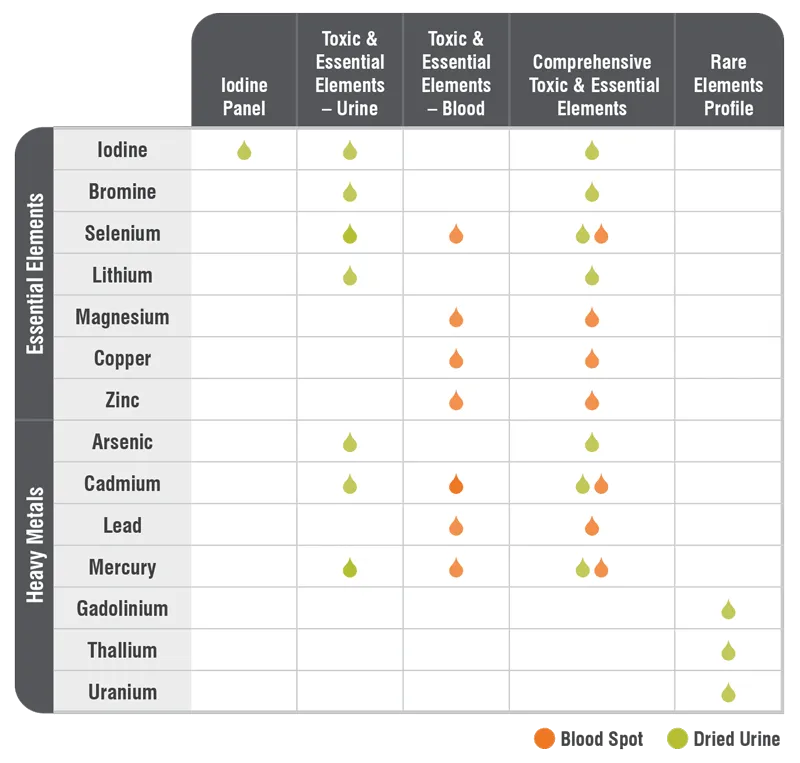
Heavy metals and essential elements affect different systems of the body, so it makes sense that they can’t all be measured in the same body fluid. ZRT tests using the most scientifically appropriate medium – either urine or dried blood spot – for our elements profiles.
For example, urinary cadmium is the best measure of accumulated exposure, while blood spot assesses only recent exposure. Blood is the only appropriate medium to assess lead exposure, and urine is the only
appropriate medium for arsenic.
Dried Urine
ZRT’s dried urine method offers a discreet, at-home testing alternative and eliminates the hassles of all-day jug urine collection. Patients collect urine on a filter strip twice during the day. Dried strips are shelf-stable for 30 days and easy to mail back to the lab for analysis.
Dried Blood Spot
Allows testers to collect samples in the privacy of their own homes and is simple and nearly painless, avoiding a trip to the phlebotomist.
Dried Blood Spot
Allows testers to collect samples in the privacy of their own homes and is simple and nearly painless, avoiding a trip to the phlebotomist.
Service Area
hours
contact us
Global Reach
1401 Malvern Avenue,
#180 Hot Springs, Arkansas 71901 USA
Monday - Friday
(8:00 am - 6:00 pm)
Central Standard Time
Saturday (Closed)
Sunday (Closed)
This is a Paragra
p h
Font

Manage Consent Preferences
Do Not Share My Information | Conditions of Use | Notice and Take Down Policy | Website Accessibility Policy
Website Payment & Customer Policies
© 2026 The content on this website is owned by us and our licensors. Do not copy any content (including images) without our consent.
Service Area
Global Reach
1401 Malvern Avenue,
#180 Hot Springs, Arkansas 71901 USA
hours
Monday - Friday (8:00 am - 6:00 pm)
Central Standard Time
Saturday (Closed)
Sunday (Closed)
contact us
Manage Consent Preferences
Do Not Share My Information | Conditions of Use | Notice and Take Down Policy | Website Accessibility Policy
Website Payment & Customer Policies
© 2026 The content on this website is owned by us and our licensors. Do not copy any content (including images) without our consent.